


Raleigh vs Durham: How to Choose
Caul Group Residential is a team with eXp Realty. Call (919) 263-7653.
Should you live in Raleigh or Durham? It depends on where you need to be each day and what you want close to home: Raleigh is the larger city, the state capital and home to NC State, with about 506,000 residents and 117 miles of greenway trails, while Durham has about 306,000 residents, is home to Duke University and starts the American Tobacco Trail downtown. Durham's combined city and county property tax rate is higher for 2026-27, about $536 more a year on a home assessed at $500,000.
This Raleigh vs Durham guide compares the two cities side by side: location and distances, commutes, downtowns, parks and greenways, the housing mix, property tax rates, city size and getting around by bus and train. Every number comes from a government or public source, linked at the end, that we checked on November 23, 2026.
Quick look: Raleigh vs Durham at a glance
- Population (U.S. Census estimate, July 1, 2025): Raleigh 506,306; Durham 305,561
- Land area (U.S. Census, 2025): Raleigh 152.3 square miles; Durham 119.9 square miles
- Distance to RDU airport: about 15 miles from downtown Raleigh (Visit Raleigh); 13.5 miles from downtown Durham (Durham Economic Development)
- Average commute to work (U.S. Census, 2020 to 2024): Raleigh 23.0 minutes; Durham 22.3 minutes
- 2026-27 property tax rate, city plus county: Raleigh $0.9091 per $100 of value; Durham $1.0163 per $100
- Greenways and trails: Raleigh 117 miles of greenway trails; Durham Parks and Recreation maintains more than 30 miles of multi-use trails and greenways
- Local buses: GoRaleigh one-way fare $1.25; GoDurham fare-free through June 2027
Location and distances
Wake County Economic Development describes Research Triangle Park (RTP) as located at the heart of the Triangle's three major cities. Its RTP profile lists RDU International Airport as adjacent to the park, Duke University 10 miles away, NC State University 14 miles away and downtown Raleigh 17 miles away.
Raleigh is North Carolina's capital and home to NC State University. Duke University's campus addresses are in Durham. Visit Raleigh places RDU about 15 miles from downtown Raleigh, and Durham Economic Development places downtown Durham 13.5 miles from RDU, about a 15-minute drive.
Both cities reach a little past their home counties. Census estimates show about 1,660 Raleigh residents living in the Durham County part of Raleigh, and about 298 Durham residents in Wake County and 147 in Orange County. That matters for taxes, covered below.
Commute
Census survey data for 2020 to 2024 shows the average one-way commute is 23.0 minutes for workers who live in Raleigh and 22.3 minutes for workers who live in Durham. The same survey shows 25.8% of Raleigh workers and 23.3% of Durham workers worked from home. About 1.4% of Raleigh workers and 1.9% of Durham workers took public transportation to work.
These are averages for everyone who lives in each city, not drive times to any one office. If you will commute to RTP, a hospital or a campus, drive the route at rush hour before you choose a neighborhood.
Downtowns
Downtown Raleigh
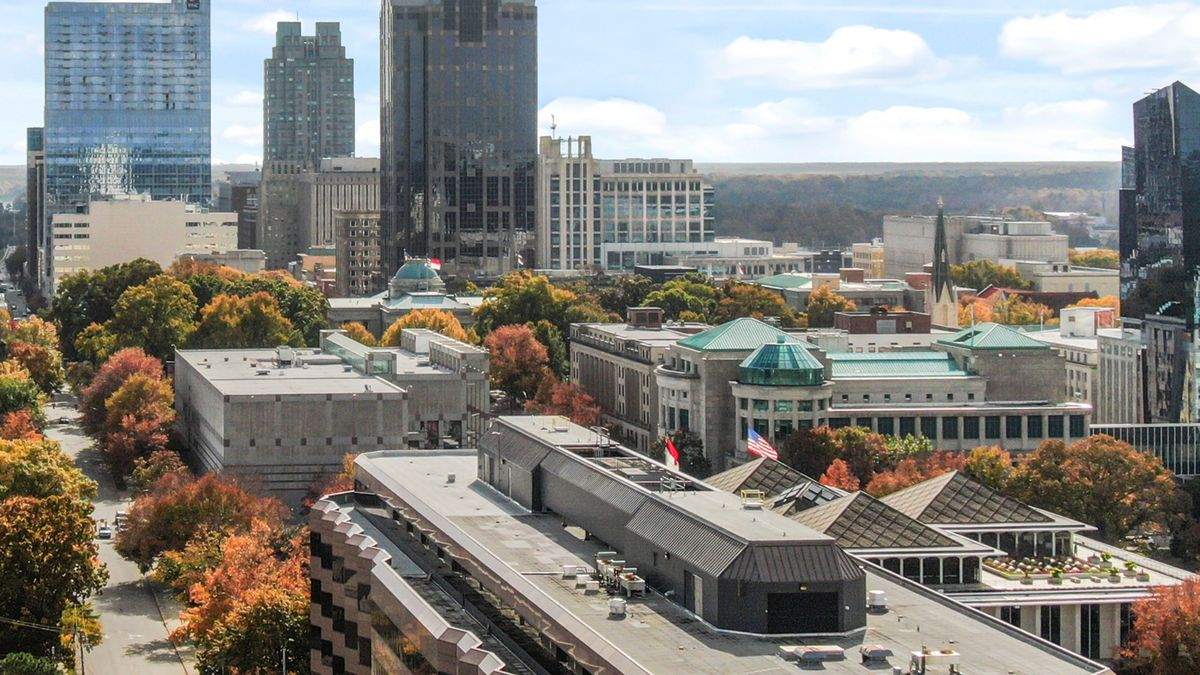
The North Carolina State Capitol has been the seat of state government since it opened in June 1840. Raleigh Union Station, the city's Amtrak station, is at 510 W. Martin Street. In the heart of Raleigh, the city owns Dix Park, a 308-acre site it acquired from the State of North Carolina in 2015. The park is open daily from dawn to dusk and includes Gipson Play Plaza, 18.5 acres of playgrounds, gardens, gathering spaces and skyline views, plus a dog park.
Downtown Durham
Downtown Durham is where the American Tobacco Trail begins, at the corner of Morehead and Blackwell Streets. The City of Durham owns the Durham Performing Arts Center (DPAC), which is managed by Nederlander and Professional Facilities Management. Durham Station, the city's Amtrak stop, is at 601 W. Main Street.
See our Raleigh area guide and Durham area guide for neighborhoods and homes in each city.
Parks and greenways
Raleigh: The City of Raleigh has 117 miles of greenway trails in its Capital Area Greenway system, made up of 28 trails along streams, the Neuse River and its tributaries. The longest is the Neuse River Trail at 27.5 miles, from Falls Lake Dam to the Wake and Johnston County line. The Crabtree Creek Trail runs 18 miles from the Neuse River Trail to William B. Umstead State Park. Several sections were closed or scheduled to close for construction when we checked, including part of the Neuse River Trail through 2027, so check the city's greenway alerts page before you go. For more on Raleigh, see our pros and cons of living in Raleigh.
Durham: Durham Parks and Recreation maintains more than 30 miles of multi-use trails and greenways, and manages over 1,600 acres of parkland in 66 parks. The Durham section of the American Tobacco Trail is 11 miles of paved trail, 10 feet wide, running from downtown south to the Chatham County line, and the trail continues toward Jordan Lake. Eno River State Park, in Durham and Orange counties about 10 miles northwest of downtown Durham, has seven access areas along the river, with hiking trails, paddling, fishing and picnicking.
Each total comes from that city's own count, so compare trail maps for the parts of town you are considering rather than the totals alone.
Housing mix and home values
Both cities have a wide mix of homes. Census survey data for 2020 to 2024 shows:
- Detached houses: 43.7% of homes in Raleigh; 50.8% in Durham
- Attached homes, such as townhomes: 14.4% in Raleigh; 10.6% in Durham
- Buildings with five or more units, such as apartments and condos: 35.0% in Raleigh; 30.8% in Durham
- Owner-occupied homes: 50.7% in Raleigh; 52.3% in Durham
- Median value of owner-occupied homes (as reported by owners): $415,800 in Raleigh; $392,800 in Durham
Census survey values are owner estimates averaged over five years, not current sale prices. For today's prices, ask for recent sales in the neighborhoods you are considering.
Property tax rates for 2026-27
Homes inside city limits pay the county rate plus the city rate. Rates are per $100 of assessed value:
- Raleigh (Wake County part): Wake County $0.5371 plus City of Raleigh $0.3720, for a combined $0.9091
- Durham (Durham County part): Durham County $0.5792 plus City of Durham $0.4371, for a combined $1.0163
On a home assessed at $500,000, that works out to about $4,546 a year in Raleigh and $5,082 a year in Durham, before any fees. That is a difference of about $536 a year at the same assessed value. For 2026-27, Wake County raised its rate from $0.5171 and Raleigh raised its rate from $0.3550. Durham County raised its rate by 2.5 cents, and the City of Durham kept its rate at $0.4371.
Assessed values matter as much as rates. Durham County's most recent reappraisal was effective January 1, 2025, and its next is scheduled for January 1, 2029. Wake County's current values date to its January 1, 2024 revaluation; its next countywide revaluation takes effect January 1, 2027, and Wake then moves to a two-year cycle starting January 1, 2029. Because the two counties set values in different years, the same house could carry different assessed values in each, so look up the actual tax record for any home you consider. Our guide on how to read a Durham County tax bill walks through the Durham side.
City size and growth
Raleigh is the larger city by people and by land. U.S. Census estimates for July 1, 2025 put Raleigh at 506,306 residents and Durham at 305,561. The Census 2025 Gazetteer lists Raleigh at 152.3 square miles of land and Durham at 119.9 square miles.
Both cities have grown at a similar pace. From the April 2020 estimates base to July 2025, the Census shows Raleigh up 8.2% and Durham up 7.6%.
Getting around: buses and trains
Buses: GoRaleigh runs local buses in Raleigh. Its one-way fare is $1.25, a day pass is $2.50, and seniors 65 and older ride free with a GoRaleigh ID. GoDurham runs local buses in Durham, and the Durham City Council's 2026-27 budget keeps GoDurham buses fare-free through June 2027. GoTriangle provides cross-county regional buses.
Trains: Both cities are on NC By Train's Piedmont route between Raleigh and Charlotte and on the Amtrak Carolinian between Charlotte and New York. Raleigh Union Station also serves the Floridian, which runs between Chicago and Miami. Train schedules change, so check NC By Train or Amtrak before you plan a trip.
Planning a move to Raleigh or Durham?
If you are moving to the Triangle, our free Triangle Relocation Guide covers nine Triangle areas with drive times, plus where locals eat, shop and spend time outdoors. Our moving to North Carolina checklist covers your DMV, tax and utility to-dos. To tour homes in both cities, contact us or call (919) 263-7653. Caul Group Residential is the #1 Resale Team in the Triangle.
Frequently asked questions
Should I live in Raleigh or Durham?
It depends on your daily drive and what you want nearby. Raleigh is the larger city, the state capital and home to NC State, with 117 miles of greenway trails. Durham is smaller, home to Duke University, and the American Tobacco Trail starts downtown. Durham's combined property tax rate is higher for 2026-27.
Are property taxes higher in Raleigh or Durham?
Durham's rate is higher for 2026-27. The combined city and county rate is $1.0163 per $100 of assessed value in Durham and $0.9091 in Raleigh. On a $500,000 assessed value, that is about $536 more a year in Durham. Assessed values are set in different years in each county, so check the tax record for the home.
Which is closer to RDU airport, Raleigh or Durham?
They are similar. Durham Economic Development places downtown Durham 13.5 miles from RDU, and Visit Raleigh places RDU about 15 miles from downtown Raleigh. Wake County Economic Development lists RDU as adjacent to Research Triangle Park.
Is Raleigh bigger than Durham?
Yes. Census estimates for July 1, 2025 show 506,306 residents in Raleigh and 305,561 in Durham. Raleigh covers about 152 square miles of land and Durham about 120.
Do the buses in Raleigh and Durham charge a fare?
GoRaleigh charges $1.25 for a one-way ride, with a $2.50 day pass. GoDurham buses are fare-free through June 2027 under the City of Durham's 2026-27 budget. GoTriangle provides cross-county regional buses.
Sources checked November 23, 2026: Wake County Tax Rates and Fees (2026 rate table); Durham County Tax Rates; Durham County FY 2026-27 budget; Durham County Real Property FAQs; Wake County Revaluation FAQ; Census city and town population estimates, Vintage 2025 (NC file); Census 2025 Gazetteer, NC places; Census ACS 2020 to 2024 5-year summary file (tables B25024, B25003, B25077, B08013, B08303, B08301); Wake County Economic Development, RTP profile; Wake County Economic Development, Raleigh profile; Durham Economic Development, Transportation and Transit; Visit Raleigh, RDU; Duke University contact; NC Historic Sites, State Capitol; City of Raleigh, Dix Park; City of Raleigh Greenway Alerts; City of Raleigh greenway trails; Durham Parks and Recreation, Trails and Greenways; Durham Parks and Recreation, About Us; Durham Parks and Recreation, American Tobacco Trail; NC State Parks, Eno River State Park; City of Durham, DPAC; GoRaleigh Fares and Passes; GoDurham fare-free through June 2027; NC By Train, Raleigh Union Station; NC By Train, Durham Station. Rates, routes and schedules can change; check each source before you rely on them.
Check out this article next
New nonstop flights from RDU in 2027, and where the runway project stands
Caul Group Residential is a team with eXp Realty. Call (919) 263-7653.Raleigh-Durham International Airport is growing in two ways: more routes and a new runway.…
Read Article